

Recent regulatory upheavals are profoundly reshaping global supply chains. With the modification of exemption rules in the European Union, importers and e-tailers are facing new tariff and logistics challenges. This development is pushing market players to rethink their distribution routes and turn to alternative hubs offering better stability. In this context, the Swiss e-commerce customs import stands out as a leading solution to maintain competitiveness and ensure the fluidity of commercial transits.
At Agence Fret Cargo, we understand the importance of agile and perfectly managed logistics. As a Swiss family business based directly at Geneva Airport, we support a demanding clientele with a personalised approach and a keen eye for detail. With 38 years of experience, we design bespoke transport solutions that meet the highest quality standards. Our strategic positioning allows us to navigate a complex customs environment with precision and offer reliable shipping services.
1. The end of the European exemption: a logistics upheaval
The abolition of the European customs exemption, now replaced by a flat-rate tax on items, has sent shockwaves through the international trade sector. This decision aims to rebalance competition, but it leads to an increase in direct costs for low-value shipments from Asia.
Consequently, air carriers have had to adjust their capacities, significantly reducing direct freight flights to the European Union. Online export volumes have suffered a drastic drop, pushing operators to seek alternatives to bypass these new constraints. The European regulatory framework now imposes an administrative rigour that slows down traditional logistics flows.
Faced with these tariff barriers, hubs located outside the European Union are experiencing a major resurgence of interest. Airport infrastructures that escape this new flat-rate tax are attracting freight flows seeking to optimise B2B and B2C transit costs.
2. The strategic advantages of the Swiss e-commerce customs import
Thanks to its status as a non-member country of the European Union, Switzerland has valuable autonomy in managing its tariff policies. This independence makes it possible to structure a Swiss e-commerce customs import that is particularly advantageous for companies seeking a flexible European landing point.

In accordance with official directives, since 1 January 2025, the value exemption for imports into Switzerland is CHF 150 (previously CHF 300). Below this amount, no VAT or customs duty is collected, as indicated by the Federal Office for Customs and Border Security. This maintained threshold offers a decisive advantage for Swiss domestic consumption.
Swiss SMEs and international importers can thus use Swiss territory as a strategic rear base. Storing goods under customs control allows the payment of taxes to be deferred until final distribution, thereby optimising cash flow and inventory management.
3. Comparison: Transit via the EU vs Transit via Switzerland
To fully grasp the impact of the recent changes, it is essential to compare the transit conditions between the European Union and Switzerland. This table highlights the major differences influencing current logistics choices.
| Logistics criterion | Transit via the European Union | Transit via Switzerland (non-EU) |
|---|---|---|
| Customs exemption | Abolished and replaced by a flat-rate tax | Value exemption of CHF 150 maintained |
| Storage flexibility | Subject to increased administrative restrictions | High flexibility thanks to customs zones |
| Airport congestion | Risk of saturation at major hubs | Fluid processes and adapted infrastructures |
| Impact on cash flow | Taxes payable upon entry into the territory | Deferred payment possible upon release for consumption |
This comparison clearly demonstrates that avoiding congestion zones and new European taxes gives Switzerland an essential role as a logistics hub for international trade.
4. The central role of Geneva Airport for B2B freight
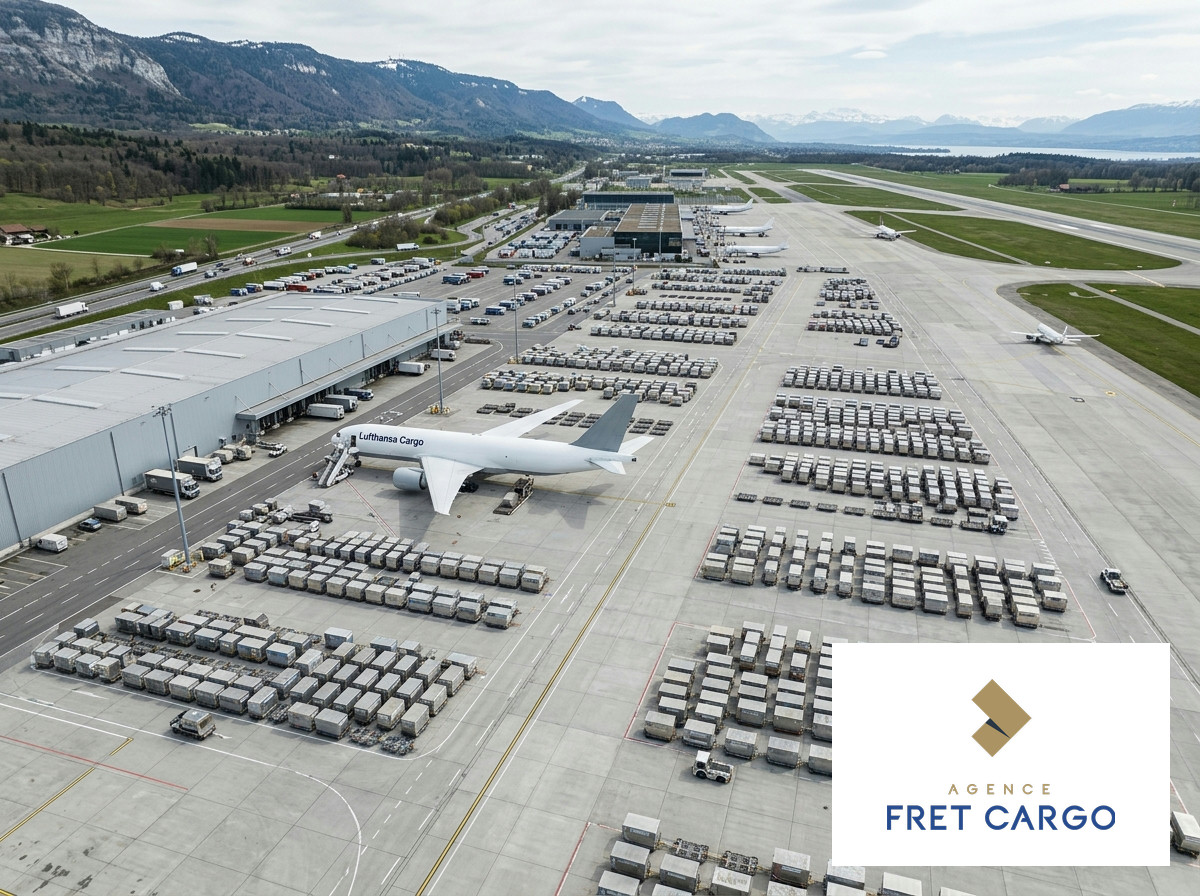
Geneva Airport is not just a transit point for travellers; it is an essential link in the global supply chain. Its dedicated freight infrastructures allow for the fast and secure processing of goods.

The airport's freight hall hosts internationally renowned handling agents such as Swissport and Dnata. These players guarantee the professional handling of cargo as soon as it leaves the aircraft. Each air shipment is identified by an Air Waybill (AWB), ensuring perfect traceability throughout the process.
Furthermore, Geneva's geographical location at the crossroads of Europe facilitates the rapid redistribution of goods by land to neighbouring markets. This multimodal connectivity is a major asset for companies requiring flawless flow management.
5. The Swiss customs system: fluidity and compliance
The success of the Swiss e-commerce customs import also relies on the efficiency of the federal administration. The deployment of digitised systems like Passar aims to simplify and accelerate goods declarations at the border.
The digitisation of customs procedures significantly reduces waiting times and minimises the risks of administrative errors. To master all the subtleties of these processes, it is highly recommended to refer to specialised resources. You can consult our detailed guide on [Customs regulations for imports into Switzerland](customs-regulations-for-imports-into-switzerland) to deepen your knowledge.
Meticulous preparation of import documents, combined with the expertise of a local freight forwarder, guarantees that goods pass through customs smoothly, thus respecting critical delivery times for B2B trade.
6. How to adapt your supply chain
To take advantage of these new dynamics, importers must rethink the architecture of their supply chain. Integrating Switzerland as a main transit point requires an in-depth analysis of shipping volumes and temporary storage needs.
The strategic use of bonded warehouses allows shipments to be consolidated before their final distribution. This method reduces the frequency of fragmented customs clearances and optimises overall transport costs. The key lies in selecting logistics partners capable of navigating this environment with ease.
The transformation of European tariff policies is profoundly reshaping international trade routes. In this rapidly changing context, Switzerland confirms its status as an essential logistics crossroads for B2B flows and e-commerce. Anticipating and adapting supply strategies remain the best levers for maintaining a high-performance distribution chain.
Contact Agence Fret Cargo
📍 Voie-des-Traz 20, 1215 Le Grand-Saconnex (Geneva Airport) 📞 +41 22 798 68 00 📧 hello@fretcargo.com
Any rates and transit times mentioned are indicative market estimates, subject to final confirmation based on your shipment details, the commodity, and current market conditions.
Let us handle the logistics — you focus on your business.